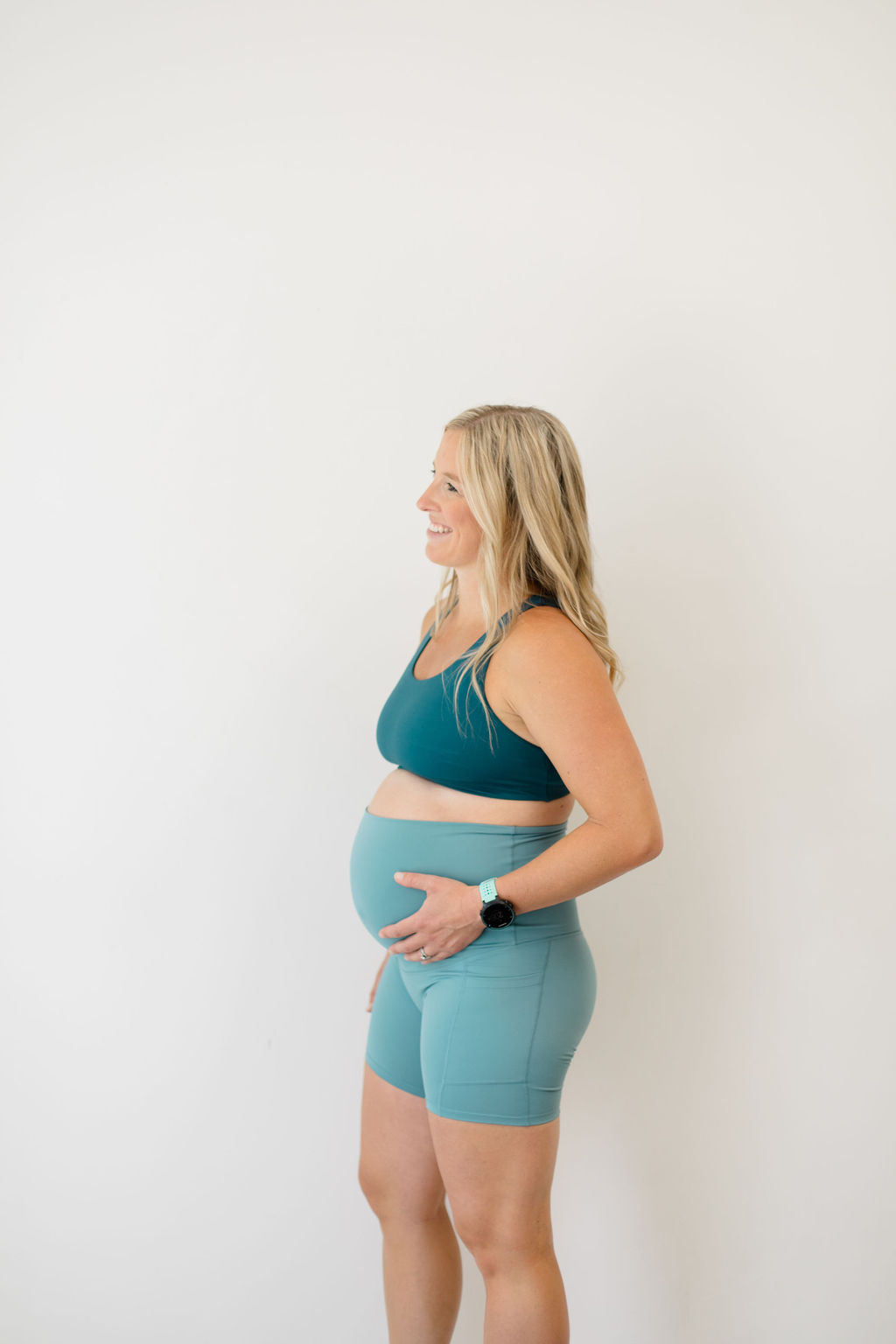
Round ligament pain in pregnancy can stop you in your tracks. It’s a sharp, stabbing sensation that makes you catch your breath.
You might mention it at your prenatal appointment and hear “it’s normal” or “it’ll go away after delivery,” which doesn’t help at all when you’re dealing with it right now.
As a pelvic floor physical therapist (and mom of four!), I know how frustrating that response feels. Round ligament pain is common, but you don’t have to just tolerate it. Pelvic floor PT exercises can help!
Here’s everything you need to know about round ligament pain in pregnancy and how to make it better.
What Is Round Ligament Pain in Pregnancy?
Round ligaments are thick bands of tissue that support your uterus. They run from the top of your uterus, down through your groin, and attach to your labia.
You can think of them as supportive cables holding your uterus in place.
During pregnancy, your uterus grows and stretches these ligaments. They have to accommodate big changes as your uterus expands from about the size of a pear to the size of a watermelon. As your baby grows and your uterus gets heavier, your round ligaments stretch and shift to support the extra weight.
This stretching is what causes round ligament pain.
What Does Round Ligament Pain Feel Like in Pregnancy?
Round ligament pain usually feels sharp and sudden. Many women describe it as a stabbing or shooting pain that comes on quickly and catches them off guard.
The pain can show up in different ways:
- A stabbing, sharp pain on one or both sides of your lower belly or groin
- A brief, intense pulling sensation when you change positions quickly
- A dull abdominal pain that lingers after sudden movements
- Pain that shoots down into your groin or upper thigh
You might feel a quick jolt that goes away within seconds or lingering discomfort, especially in the later weeks of your pregnancy. The pain often happens when you move suddenly—standing up from sitting, getting out of bed, coughing, sneezing, or laughing.
You might notice that round ligament pain gets worse as your pregnancy progresses and your belly gets bigger. This makes sense because your round ligaments are working harder to support more weight.
Round ligament pain typically shows up in the second trimester, when you’re experiencing the most rapid growth. If you notice it early on, pay attention! It’s often a warning sign that your body mechanics are off.
Addressing it now can prevent the pain from getting worse later on.
Learn more about how to relieve pelvic pain during pregnancy.
Where Do You Feel Round Ligament Pain?
You typically feel round ligament pain in your lower abdomen, along the sides of your uterus, or in your groin. It’s most common on the right side, but it can happen on the left side or both sides at once. However, on one side is the most common.
What Causes Round Ligament Pain During Pregnancy?
Round ligament pain happens because your round ligaments are stretching to support your growing uterus. These ligaments aren’t designed to stretch this much under normal circumstances, so the fast growth during pregnancy puts a lot of strain on them.
When you move suddenly or change positions quickly, your round ligaments tighten and then relax rapidly. This quick contraction and release causes the sharp, stabbing sensation you feel.
Your round ligaments are also sensitive to hormones, especially relaxin, which increases during pregnancy and makes your ligaments more flexible and prone to stretching.
Learn more about another uncomfortable and common symptom, sciatica during pregnancy.
How to Help Round Ligament Pain in Pregnancy?
The American Pregnancy Association defines round ligament pain as a “normal” part of pregnancy and recommends rest as one of the best ways to manage it, but I disagree with this kind of approach.
Yes, round ligament pain is common during pregnancy. But that doesn’t mean you have to just wait it out. Telling pregnant women to rest and hope it goes away dismisses the (often severe) pain and discomfort that affects their daily lives for many, many long weeks.
If round ligament pain is making it hard to move through your day, stopping you from exercising, or disrupting your sleep, you deserve better options than just waiting for your baby to arrive!
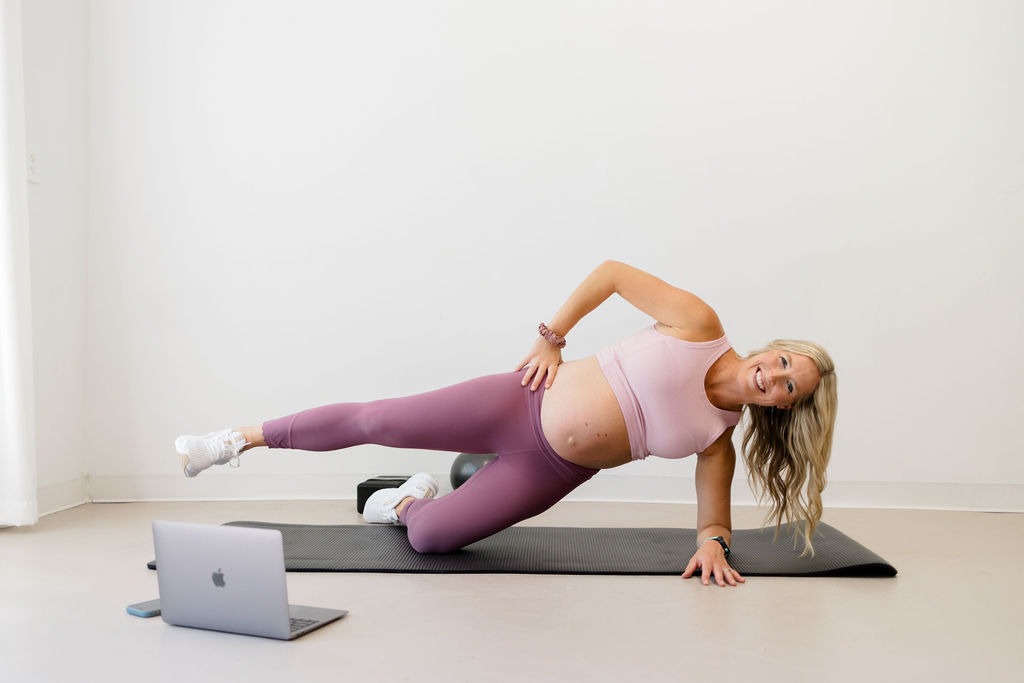
Pelvic floor physical therapy can help ease round ligament pain during pregnancy.
Pregnancy is a time when your body needs progressive support. As your belly grows and your hormones loosen your ligaments, your muscles naturally lose some of their strength and coordination. Your abdominal muscles stretch and separate to make room for your baby, and your center of gravity shifts forward, putting more strain on your back and pelvis.
Pelvic floor physical therapy gives your muscles the strength and stability they need to support your growing uterus, which takes pressure off your round ligaments and reduces pain.
Learn more about when to start pelvic floor therapy during pregnancy and how it can help.
Exercises for Round Ligament Pain Pregnancy Relief
Here are 5 pelvic floor physical therapy exercises to help you relieve round ligament pain during pregnancy. You can find more of them in my program, Strong Expecting Mama!
Exercise 1: Half-Kneeling Hip Flexor Stretch
- Go into a half-kneeling position with your knee up and your leg behind you.
- Do a slight posterior pelvic tilt by tucking your pelvis under (this counters the forward shift that happens naturally in pregnancy).
- Shift your hips slightly forward to feel lengthening in the front of your hip.
- Take your arm and reach it across your body.
- Inhale through your nose, then exhale as you reach gently forward into a deeper hip flexor stretch, stretching through your side body as well.
- Hold for a few breaths.
- Repeat on both sides.
Exercise 2: Sidelying Apical Expansion with Arm Reach
- Prop yourself onto your right hand and bring your right leg in front of you with your left leg behind you, both knees bent.
- Inhale through your nose, then exhale as you reach your left hand forward, stretching your right chest wall down toward the mat.
- Continue breathing slowly, inhaling through your nose and exhaling through your mouth, and go a little lower by bending your right elbow.
- Keep your right shoulder pushing away from your ear so your neck stays relaxed.
- Hold this position for a couple of breaths, focusing on lengthening your right side of the body.
Exercise 3: Sidelying Thoracic Rotation
- Grab a foam block or small ball to place between your knees.
- Lie down on your left side and prop yourself up on your left elbow.
- Reach your right arm forward and in front of you.
- Inhale through your nose as you reach your right arm up toward the ceiling and back behind you, opening up your chest as much as you can.
- Hold there and breathe, keeping your hips square and giving a gentle squeeze to the ball so your pelvis stays in a neutral position.
- Slowly come back to the starting position.
- You can straighten your arm completely to intensify the stretch.
Exercise 4: Sidelying Swiss Ball with Apical Expansion
- Get a large exercise ball or something similar, like an ottoman.
- Lie on the ball with your left side down and position yourself up against a wall so you don’t roll around.
- Extend your right leg out and reach your right arm over the ball, lengthening your right side body.
- Inhale through your nose, then exhale through your mouth.
- As you inhale, breathe into your right rib cage.
- As you exhale, try to lengthen a little more forward over the ball.
- Hold for a few breaths, feeling the stretch along your right side.
Exercise 5: Modified All Four Belly Lift
- Grab a small ball and go into a hands-and-knees position with the ball between your knees.
- Round your back up toward the ceiling and tuck your pelvis underneath you (this is not a cat-cow movement, you’re staying in this rounded position!).
- Inhale through your nose, letting your belly relax as you breathe into your back and side rib cage.
- On the exhale, gently draw your belly toward your spine, engaging your deep core.
FAQs
When does round ligament pain start in pregnancy?
Round ligament pain typically starts in the second trimester, usually between weeks 14 and 20. This is when your uterus is growing rapidly and starting to move up out of your pelvis. Some women notice it earlier, especially if this isn’t their first pregnancy. The pain can continue through the third trimester as your belly gets bigger and your round ligaments continue stretching. Every pregnancy is different, so you might experience round ligament pain earlier or later than this typical timeframe.
Does round ligament pain get worse with each pregnancy?
Round ligament pain can feel more intense in subsequent pregnancies. Your abdominal muscles and ligaments have already been stretched from previous pregnancies, which means they may have less support to offer as your uterus expands again. Your body also tends to show earlier in the second and third pregnancies because your muscles and ligaments stretch more easily. This earlier and faster growth can mean round ligament pain shows up sooner and feels sharper.
That said, it doesn’t have to be this way! My third and fourth pregnancies were my most comfortable because I was doing pelvic floor PT exercises throughout. I see the same thing with my patients. Women who work with me in their second or third pregnancies consistently notice way less pain and discomfort than they had the first time around. When you give your body the strength and stability it needs through targeted exercises, you can prevent round ligament pain or minimize it a lot, even in subsequent pregnancies.
Can round ligament pain hurt on just one side?
Yes, round ligament pain can often affect just one side. Your right round ligament is more likely to hurt because your uterus naturally rotates slightly to the right during pregnancy. This puts more strain on it. You might feel pain only on the right side, or you might notice that the right side hurts more than the left.
Can you treat round ligament pain?
You can’t “treat” round ligament pain because it’s not a medical condition, it’s your body adjusting to pregnancy. But pelvic floor physical therapy can help a lot! The exercises strengthen the muscles that support your growing belly and teach you how to move in ways that don’t strain your ligaments as much. In my practice as a pelvic floor physical therapist, women who start exercises to stabilize the pelvis and core consistently report significantly less pain. Many find that their round ligament pain resolves completely.
Pelvic floor therapy also helps with other common pregnancy discomforts like pelvic girdle pain, sciatica, rib pain, and back pain.
Reduce Pregnancy Pain with Strong Expecting Mama
Strong Expecting Mama is my pelvic floor physical therapy program for all trimesters of pregnancy.
I created it to give you the same evidence-based exercises and education I teach my in-person patients, but you can do it at home on your schedule!
Inside the program, you get:
- Progressive core and pelvic floor exercises
- Education about your pelvic floor, core, and how pregnancy affects your body
- Access to ask me questions as you work through the program
You don’t have to wait months for a physical therapy appointment or drive to a clinic every week. Everything you need is in the program, and you can work through it at your own pace!
Join Strong Expecting Mama and start feeling better during your pregnancy!
