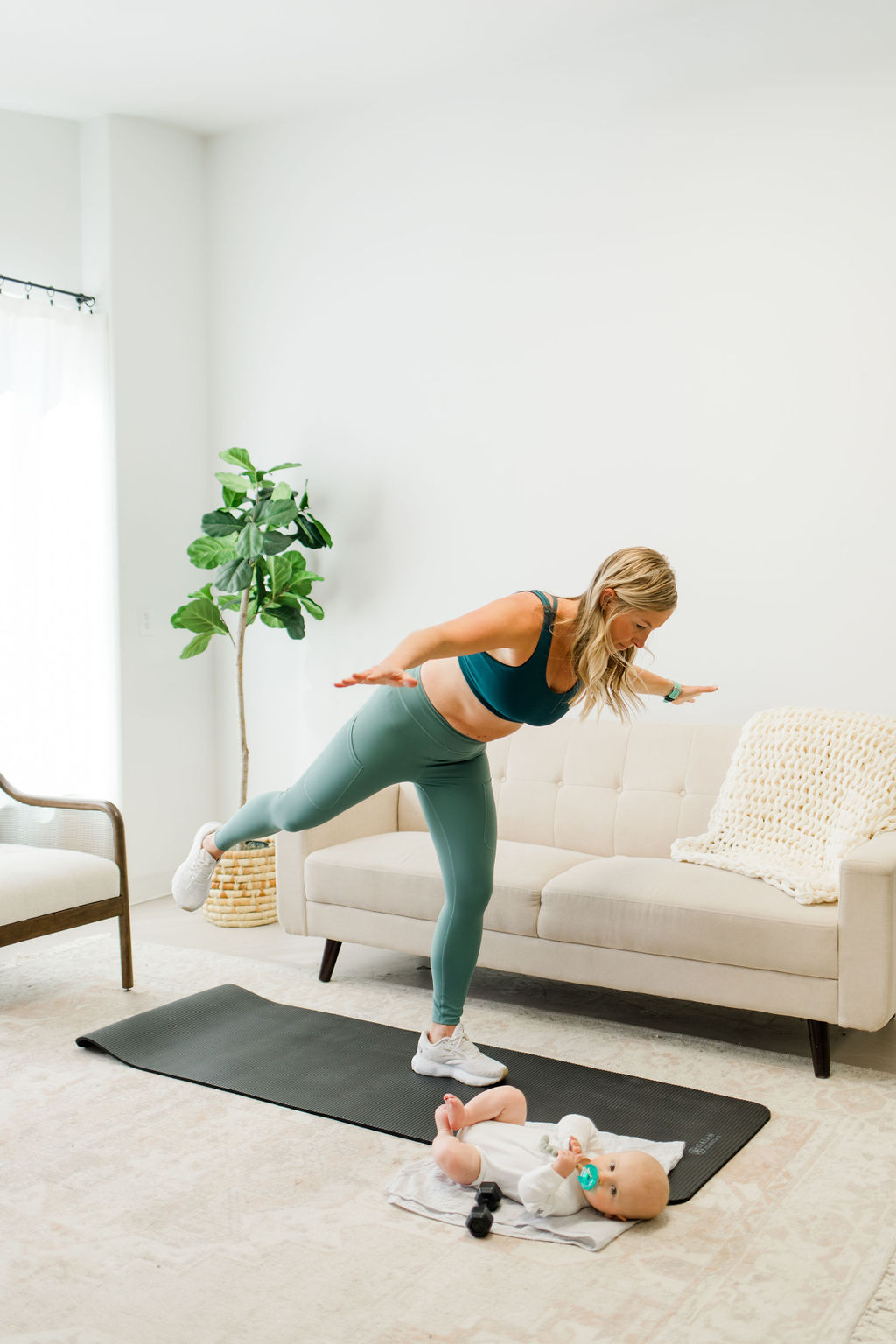
If you’re dealing with postpartum back pain, it can be very uncomfortable. Whether it’s a dull ache or sharp pain that makes it hard to lift your baby, back pain after having kids is common, but it does NOT mean that it’s normal or something you have to live with!
As a pelvic floor physical therapist, I see moms struggling with back pain postpartum all the time, and waiting it out usually makes things worse, not better. So, in this post, I’ll share 5 physical therapy exercises that can help with pain relief and retrain your muscles.
What Is Postpartum Back Pain?
Postpartum back pain is any pain or discomfort you feel in your back after having a baby. It can show up in your upper back or in your lower back and hips.
Sometimes it’s more of a constant ache, but some moms also feel sharp pain when they bend over to pick up their baby or spend time nursing in awkward positions.
More than 67% of women experience back pain after delivery, and 37% still have it at their follow-up appointments weeks later.
But when you look at more research, the numbers get a little more confusing. Studies show that postpartum back pain is poorly understood, with estimates ranging from 2% to 75% of women experiencing it for up to 3 years. That’s a HUGE range!!
The problem is that there isn’t a lot of solid information on how to deal with back pain postpartum beyond generic tips like “use a heating pad.” It’s one of those things that gets easily dismissed. You’re kind of expected to break your back when carrying babies, but it’s not supposed to be like that!
As a sports med and pelvic floor PT, I hear stories like this all the time:
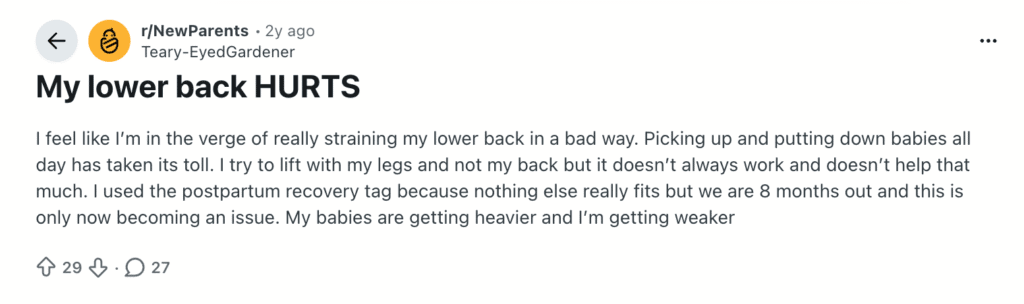
Unfortunately, this is a common experience I see in the PT clinic.
Back pain often becomes chronic back pain and gets worse as your babies get heavier, because being a mom requires you to be strong and physically capable. Carrying car seats, lifting toddlers, bending over cribs, and spending hours in feeding positions all put major demands on your body.
When your back is already struggling, these daily tasks only make things harder.
Lower Back Pain Postpartum
Lower back pain postpartum usually shows up in your lumbar spine and can radiate down into your hips or glutes.
You might feel it when you stand up from sitting or playing with your baby on the floor, when you’re holding your baby on one hip, or at the end of a long day of being on your feet.
Middle and Upper Back Pain Postpartum
Middle and upper back pain postpartum typically happens between your shoulder blades and across your mid-back.
This type of pain often comes from the rounded-forward posture that nursing, bottle feeding, and constantly looking down at your baby creates. It can also come from baby wearing, especially if you do it for long periods of time.
During pregnancy and postpartum, your back often loses mobility, your posture becomes poor, and the right muscles stop being strong enough to stabilize your core and shoulder blades. Because of this, your muscles can tense and start aching.
What Causes Postpartum Back Pain?
First things first, your back pain after pregnancy isn’t just a “part of being a mom.”
During pregnancy and delivery, your body goes through major changes that affect how your back functions. One of the biggest factors I see is loss of spinal mobility.
Your spine is designed to move, but during pregnancy, your movement becomes more limited as your belly grows. For years, pregnant women were even told not to rotate at all!
And postpartum, that restricted movement doesn’t just go away on its own. When your spine can’t move the way it’s supposed to, the muscles around it get stiff, tight, and painful.
On top of that, other things are going on, too:
- Your abdominal muscles stretch and separate (diastasis recti), which means they can’t support your spine
- Your back muscles compensate for weak or disconnected core muscles, leading to tension and pain
- Your glute muscles often stop firing properly because of pregnancy-related weakness and habitual butt clenching, so your back has to pick up the slack
- Hormones like relaxin loosen your ligaments and joints to prepare for birth, but this can leave your spine and pelvis less stable postpartum
- Your center of gravity shifts during pregnancy, changing your posture and putting extra strain on your lower back
- The physical demands of labor and delivery can strain your back muscles and pelvic floor
- Carrying your baby, nursing in hunched positions, and repetitive lifting create new postural patterns that stress your back
After delivery, your body doesn’t automatically snap back to how it was before.
Your core muscles need to be retrained, and your back muscles need support so that they can stop compensating for everything else that’s not working properly. In my practice, without addressing these root causes, back pain postpartum often persists or gets worse over time.
How to Relieve Postpartum Back Pain?
Physical Therapy
Pelvic floor physical therapy addresses the underlying reasons for postpartum back pain.
Your core muscles, diaphragm, pelvic floor, and back all work together as a system. When one part isn’t functioning well, the others have to pick up the slack.
After delivery, your back muscles often end up doing extra work to stabilize your body, which is why they get tight, tired, and painful.
Pelvic floor PT teaches you how to reconnect with your back and abdominal muscles, retrain your breathing patterns, and rebuild strength in a way that takes pressure off your back.
In other words, seeing a pelvic floor or pre/postnatal physical therapist provides pain relief AND fixes the root cause.
At the same time, seeing a PT in person isn’t realistic for many moms because of time, childcare, location, or cost. This is why I created my online program, Strong Core Mama.
Inside, you’ll find the same exercises and techniques I use in my practice as a core and pelvic floor PT for persistent back pain, but at a fraction of the cost and easy to do at home.
It’s also what I’ve personally used after all 3 of my kids to keep my herniated discs and chronic back pain from coming back, so that I can run and lift pain-free!
Better Habits + Body Mechanics
In addition to pelvic floor physical therapy, making adjustments to how you move through your day can help protect your back and prevent pain from getting worse.
Here are a few tips:
- Practice diaphragmatic breathing into your belly, sides, and back ribs to help your core and pelvic floor support your spine
- Hinge at your hips instead of rounding your back when you bend down to pick up your baby—you should feel your glutes lengthen as you hinge
- Bring your baby to you when feeding instead of hunching forward, and use pillows to support your arms
- Keep your baby close to your body when carrying them instead of holding them away from you
- Alternate which hip you use when holding your baby instead of always favoring one side
- Roll to your side and push up with your arms when getting up from the floor
- Shift positions often when you’re on the floor playing with your baby
These adjustments can help make chronic pain better and reduce daily strain on your back. BUT the underlying muscle weakness and coordination issues are still there, so better habits don’t replace physical therapy. They work together to reduce pain over time.
5 Postpartum Back Pain Exercises to Try
These are the postpartum back pain exercises I often recommend to my patients in the physical therapy clinic in the postpartum period and beyond! They can help with chronic low back pain, upper back pain, mid-back pain, and general muscle tension.
1. 90/90 Hip Lift with Arm Reach
- Lie on your back with your heels up on the edge of a chair, positioning your hips and knees at 90-degree angles
- Place a ball between your knees
- Do a slight posterior pelvic tilt by pushing your lower back down into the floor and lifting the tip of your tailbone off the mat
- Reach your hands up toward the ceiling
- Inhale through your nose, then exhale through your mouth as you reach up toward the ceiling
- Take a couple of breaths in this position
2. Prone Glute Lift with Hamstring Inhibition
- Lie on your belly with a pillow under your hips and stomach
- Start with your knees bent and prop up on your toes (one leg)
- Squeeze your glutes (put your hand on your butt to feel the squeeze!)
- Hold the squeeze and lift your knee off the mat, which should intensify the glute squeeze
- Hold for a couple of seconds, then slowly come back down
- To make it harder: squeeze your glutes first, lift your knee second, then lift your toes half an inch off the mat while keeping your back relaxed (the lift should come from your glute, not your back!)
3. Modified All-Four Belly Lift
- Start on your hands and knees with your hands underneath your shoulders and knees underneath your hips
- Tuck your pelvis underneath you in a posterior pelvic tilt
- Inhale through your nose, then exhale through your mouth while pulling your hipbones together and engaging your low, deep core
- With your next breath, lift one hand up a couple of inches and hold for a couple of breaths
- Inhale through your nose, then exhale through your mouth, drawing your hipbones together and engaging your deep core
- Switch sides and keep alternating, taking a couple of breaths on each side
4. Side Plank Hip Lifts
- Position yourself on the same elbow and knee with your other leg extended out into a modified side plank
- Inhale through your nose as you lower your hips down
- Exhale through your mouth as you lift your hips up
- You should feel your bottom hip, side abs, and hip muscles working
5. Quadruped Thoracic Rotation
- Start on your hands and knees and place a ball between your knees
- Put one hand behind your head
- Slowly rotate your elbow up toward the ceiling while keeping your hips square toward the mat
- Inhale through your nose, exhale through your mouth, and hold for a couple of breaths
- Slowly bring your elbow back down and switch sides
- You should feel a stretch in your spine as you alternate between sides
Should I Try Postpartum Stretches for Back Pain?
Gentle stretching can sometimes help tight muscles feel better in the moment, but it doesn’t fix the root cause of postpartum back pain. The real issue is typically weakened muscles and improper body mechanics, not tight muscles that need to be stretched.
What does help is rebuilding strength, restoring proper coordination between your core, pelvic muscles, and back, and doing mobility exercises that help your spine move the right way.
Mobility work is different from stretching! It helps retrain your spine to flex, extend, and rotate again instead of just loosening up tight spots.
How Long Does Postpartum Back Pain Last?
For some moms, back pain goes away on its own within a few months postpartum as their body adjusts and recovers. But for many others, it persists or turns into severe pain over time.
In my practice, I see moms who are years postpartum and still struggling with back pain. I often hear comments about how this is just expected when you’re a mom because carrying babies makes you hunch over.
I wish more moms knew that back pain postpartum is something you can treat!
FAQs
Does Walking Help Postpartum Back Pain?
Walking can be helpful for postpartum back pain because it gets your body moving. But walking alone won’t fix the muscle weakness and coordination issues that are causing your back pain. Physical therapy that retrains your core and pelvic floor muscles is what makes lasting improvement. Walking is a great addition, but it doesn’t replace exercises and proper rehab!
Can Diastasis Recti Cause Back Pain?
Yes, diastasis recti can contribute to postpartum back pain. When your abdominal muscles are separated and weakened, they can’t support your spine and pelvis the way they’re supposed to. This forces your back muscles to work harder to stabilize your body, which leads to tension, fatigue, and pain. Healing diastasis recti and restoring proper core function often helps reduce back pain.
Can an Epidural Cause Long-Term Back Pain?
This is a common worry, but research shows that epidurals don’t typically lead to chronic back pain. You might have some soreness at the injection site for a few days or weeks after giving birth, but this usually goes away on its own. If you’re experiencing back pain months or years after having your baby, it’s much more likely related to the physical changes of pregnancy and weakened core muscles.
Can Breastfeeding Cause Back Pain?
Not breastfeeding itself, but the positions you hold while nursing can contribute to pain in your back and neck muscles. When you hunch forward over your baby or round your shoulders, you create strain on your upper back. This stress adds up over multiple feeding sessions throughout the day. Try using nursing pillows to bring your baby up to you!
Who to See for Postpartum Back Pain?
You need to see a pelvic floor physical therapist for postpartum back pain. They’ll help you assess your breathing patterns, core strength, pelvic floor function, and movement mechanics to create a treatment plan that gets you feeling better and prevents back pain from coming back.
Get Help with Back Pain After Pregnancy in Strong Core Mama!
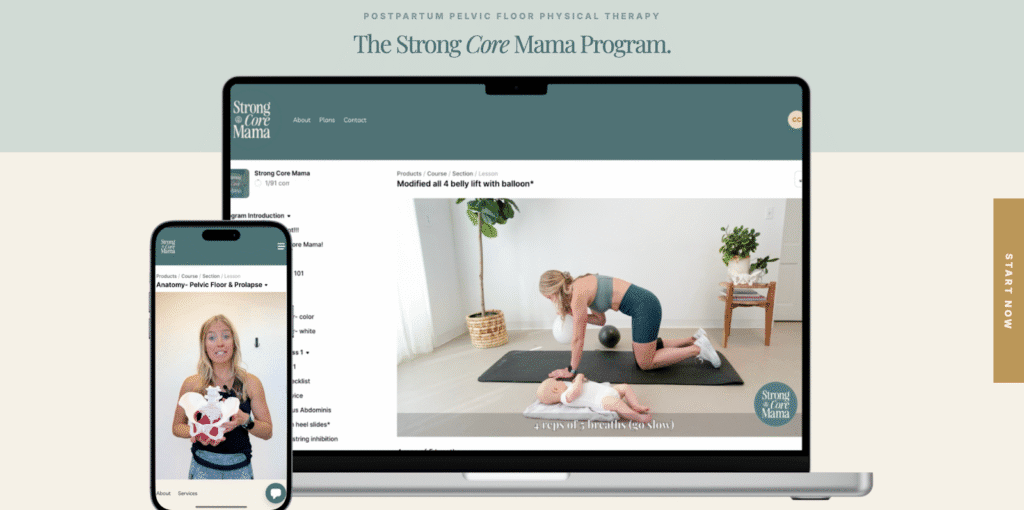
If you’re dealing with back pain postpartum, Strong Core Mama can help! This is my online physical therapy program for moms who want to heal their core and pelvic floor and feel strong in their bodies.
Inside you’ll get:
- Evidence-based exercises that retrain your core, pelvic floor, and glutes
- Step-by-step video tutorials that show you how to do each exercise correctly
- Education about how your body works
- Direct access to me to ask questions and get personalized support
Strong Core Mama fits into your busy life at home, so you don’t have to worry about childcare, scheduling costly appointments, or driving to a clinic.
You can do the exercises on your own time and at your own pace while still getting expert guidance from a practicing pelvic floor PT!
If you’re tired of living with back pain and ready to feel strong + pain-free in your body, join Strong Core Mama today!
